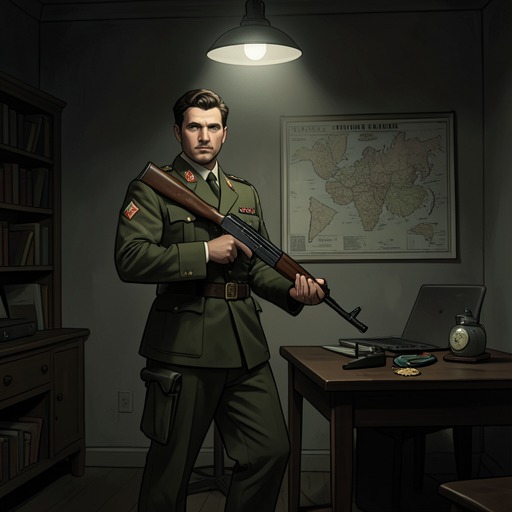
Arnaud Langer
Promise at DawnArnaud Langer is a wartime pilot remembered for bringing a damaged bomber safely down after being blinded during a mission. The episode makes him the center of a tightly shared emergency: he must fly without sight while his navigator, Romain Gary (narrator), is wounded and the aircraft is losing power. Langer survives, recovers his vision, and continues as an air transport pilot, but dies in a later landing approach when lightning strikes his cockpit.
Identity and wartime role
The memoir presents Langer chiefly through his work as a pilot and through the crisis that exposes the dependence of a crew on one another. He is at the controls of a Boston bomber, with Gary as navigator and Bauden as machine gunner. Armor plating separates the men in flight, limiting what they can do physically to help one another. Their roles therefore become sharply distinct: Langer must control the aircraft, while Gary must navigate and respond to the changing danger from his position in the nose.
The account supplies little background about Langer before this mission. Instead, it defines him through action under pressure and then briefly follows his life beyond the war. This concentrated presentation makes the successful landing the episode through which the reader first understands his skill and vulnerability; the later facts of his recovery and civilian flying extend, rather than replace, that portrait.
The blinded pilot and the return flight
During a mission among exploding shells, Gary hears Langer report that he has been hit in the eyes and is completely blind. Gary, too, has been wounded. The aircraft remains in formation, and the target is only minutes away. As navigator of the leading aircraft, Gary decides that they should continue to the target, release their bombs, and deal with the emergency afterward. The crew does so, sustaining further hits before turning away from the formation.
The return becomes more precarious when one engine fails. Langer tries to clear the fragments from his eyes and can still make out the outline of his hand. That limited perception gives the crew some hope, but it does not remove the central problem: he cannot see well enough to land unaided. Their plan to bail out after crossing the English coast also becomes impossible when Langer discovers that the aircraft’s sliding roof has been damaged. They cannot leave the blind pilot alone aboard, so they remain with him and try to guide him toward a landing.
The attempts are difficult. The aircraft overshoots the airfield twice amid the confusion of Very lights, and on the third approach the ground appears to move around them. Gary, badly wounded and seated in the bomber’s nose, cannot take over the controls. Langer nevertheless manages the landing. The official Royal Air Force account emphasizes the physical difficulty: during the landing, he held his eyes open with the fingers of one hand despite the fragments embedded in his eyelids. The memoir marks the outcome as an exceptional feat, while keeping the crew’s shared predicament in view: Langer flies blind, and the others can only try to direct him.
Recovery and life after the mission
Langer’s blindness proves temporary. The fragments had injured his eyelids but had not damaged his optic nerve, and he recovered his sight completely. The successful landing earned him the British Distinguished Flying Cross. After the war, he became an air transport pilot, carrying his experience of wartime flying into a different form of aviation.
His story is thus not confined to a single moment of crisis. The episode first makes his survival seem uncertain, then reverses that expectation: he lands the bomber, regains his sight, and resumes a flying career. The memoir does not describe the intervening course of his recovery or provide further details of his postwar work, but it establishes both outcomes plainly. The contrast matters to the account’s shape: the emergency is extraordinary, yet Langer’s later return to flying prevents it from becoming the final definition of his life.
Death and narrative afterecho
In June 1955, Langer was approaching a landing at Fort-Lamy a few seconds ahead of a tropical tornado. Witnesses saw lightning strike his cockpit, killing him instantly. The memoir places this death after the account of his earlier survival and recovery, turning a story of an impossible landing into one with a final, sudden reversal. The narration observes that it took this blow for fate to catch up with him.
That ending echoes the earlier mission without making the two events equivalent. In wartime, Langer had survived blindness and damage to his aircraft through his own flying and the crew’s efforts to guide him; years later, lightning killed him during another approach to landing. The account gives no further explanation of his death or his life between the war and 1955. Instead, the abruptness of the final report sets his celebrated survival beside a later loss that no skill or crew intervention could prevent. Langer’s place in the memoir rests on that tension: a pilot capable of bringing a blinded aircraft down safely, whose eventual death arrives in a flash during an ordinary act of flying.